Phesgo®
(pertuzumab & trastuzumab)
Pronounced Fes-go
Phesgo is the combination of Perjeta® (pertuzumab) and Herceptin® (trastuzumab) given as a single subcutaneous injection. Phesgo is a targeted therapy for the treatment of early HER2-positive breast cancer and advanced HER2-positive breast cancer.
Ask your doctor if Phesgo is right for you.
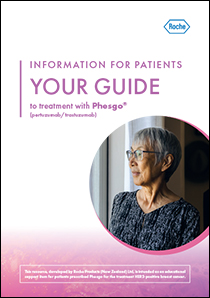
Phesgo patient booklet
This booklet contains useful information on Phesgo such as what it is for, how it works, things to consider before starting treatment and what to expect during treatment including side effects.
DOWNLOADHow to access Phesgo
Phesgo for HER2-positive breast cancer is a funded medicine for metastatic breast cancer from 1 December 2025 for patients who meet defined criteria. A prescription charge and doctor’s fees apply. Phesgo is an unfunded medicine for neoadjuvant or adjuvant treatment of early breast cancer. This means you will need to pay for it privately.
If you have health insurance, carefully check what’s covered — every health insurance provider has different rules and benefits that cover cancer treatment, surgery, tests and appointments. Roche also offer support through a Cost Share Programme.
The Phesgo Cost Share Programme
• offers assistance with the cost of your medicine. A number of doses (or cycles) of the medicine are provided at no charge (the cost of the medicine only – doctors fees and administration costs will still apply).
• for more information on the Phesgo Cost Share Programme, please talk to your doctor.
Ready to take the next step
Making decisions about treatment options involves working through the advantages and disadvantages, so you can decide what may work best for you and your loved ones.
Because every situation is different, it’s important to speak to your doctor to find out if Phesgo is right for you.
Talking to your doctor about Phesgo
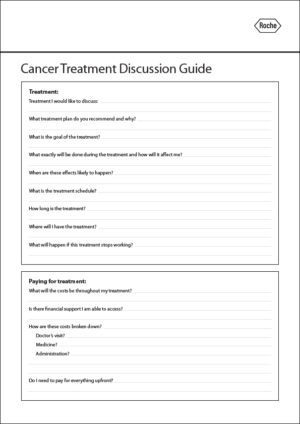
To help you in this process, we’ve put together a discussion guide to help you begin a conversation with your doctor. Print it off, take it along to your next appointment, and take notes in the spaces provided.
For further information about private treatment providers click here.
You can also talk to your current doctor about referral to a private doctor or treatment centre.
To learn more about how medicines become available in New Zealand, click here.
Handy resources
The following resources contain useful information on Phesgo such as what it is for, how it works, things to consider before starting treatment and what to expect during treatment including side effects.
Phesgo patient booklet
DOWNLOAD
Phesgo Patient Booklet – Te Reo Māori
DOWNLOAD
What does my pathology report mean?
DOWNLOAD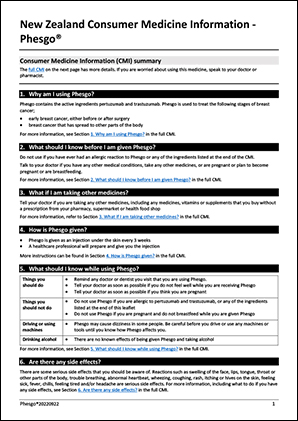
Phesgo Consumer Medicine Information
DOWNLOAD